A nationwide study in the journal Osteoporosis International counted 2,515,245 stair-related injuries among Americans 65 and older between 2012 and 2021, using the federal injury-surveillance database that tracks emergency-room visits, and the most common serious result was an upper-extremity fracture, about 251,041 of them. Stairs are the most dangerous stretch of floor in a house, and carpet is one of the few changes that makes them measurably safer, because it adds grip underfoot and cushions a fall if one happens. The catch is that stairs and busy hallways are also where carpet wears out first, so the trick is choosing a carpet built to survive the traffic while it does that safety work.
Durable carpet for stairs and high-traffic rooms comes down to four things you can actually check: the fiber, the twist, the density, and the pile type. Face weight, the number most people ask about first, matters far less than the other three. Here's what each spec does, which carpet holds up where the house works hardest, and how a stair carpet has to be installed to stay safe, from a Lincoln team that fits carpet in these homes every week.
What makes carpet durable in high-traffic areas?
Carpet durability comes from four specs working together: fiber type, twist, density, and pile construction. The Carpet and Rug Institute, the trade association for American carpet manufacturers and the group whose testing and labeling most of the industry follows, points to fiber and construction as the traits that decide how a carpet wears. A carpet that survives a staircase gets all four right at once: a resilient fiber that springs back, a tight twist that resists untwisting, a dense pile that resists crushing, and a construction that hides wear rather than showing it. Miss one and the carpet mats down in the walk path within a couple of years, which is the flattened, traffic-worn track you see on tired stairs.
Which carpet fiber holds up best on stairs and halls?
Nylon is the most resilient carpet fiber, which is why it's the usual pick for stairs and busy hallways. The Carpet and Rug Institute groups residential carpet into five pile fibers, nylon, polyester, polypropylene, triexta, and wool, and notes that each brings different durability, abrasion resistance, and texture retention. Nylon's strength is resilience: its fibers bounce back after being crushed underfoot, so it keeps its look in a walk path longer than the others. That memory is exactly what a stair demands, because every step lands on the same few inches of carpet thousands of times a month.
The other fibers each have a lane. Polyester, often labeled PET, is soft and naturally stain-resistant and shows rich color, but it crushes more easily than nylon, so it fits bedrooms better than stairs. Triexta is a newer fiber with good durability and built-in stain resistance that has become a strong family-floor option. Polypropylene, also called olefin, resists stains and fading cheaply but has little resilience, so it works best as a low loop rather than a plush. Wool is the natural premium choice, resilient and beautiful, at a price that usually sends it to formal rooms. For a staircase that has to look good for years, nylon or a quality triexta is the safe money.
What is twist, and why does it matter on stairs?
Twist is how tightly the carpet yarn is wound, counted as turns per inch, and it's one of the clearest signs of a durable carpet. Picture the individual yarn tufts: a loosely twisted tuft frays and opens up at the tip under traffic, going fuzzy and matted, while a tightly twisted tuft stays bundled and springy. The Carpet and Rug Institute puts it plainly, that a highly twisted yarn holds its shape longer and is the smart choice for high-traffic areas. On a stair, where feet grind down on the tread edge with every trip, a high twist is what keeps the carpet from looking worn out years before it should. You can see twist for yourself on a sample: the tighter and more defined each tuft looks, the better it will wear.
Why density beats face weight
Density, meaning how tightly the fibers are packed into the backing, predicts wear better than face weight does, and confusing the two is the most common carpet-shopping mistake. Face weight measures the ounces of fiber per square yard, so it tells you how much yarn is there but nothing about how it's arranged. Two carpets can carry the same face weight, and the one that spreads its yarn into a taller, looser pile will crush and mat while the denser one holds up. There's a simple test you can do in the showroom: bend a sample back on itself and press your fingers into the pile. If you can easily see or feel the backing between the tufts, the carpet is loosely packed and will wear faster. If the pile is dense enough that the backing barely peeks through, it will stand up to a staircase. The test takes five seconds. Density costs a little more, and on stairs it's the spend that pays back.
Cut pile or loop for stairs and high-traffic rooms?
Both cut pile and loop work in high-traffic areas, and the better pick depends on the room and whether pets use it. A loop pile, where the yarn is left as uncut loops, gives a uniform look that the Carpet and Rug Institute says holds up well in high-traffic areas, and level-loop and low-profile berber styles are popular in halls and basements for that reason. The caution with loops is pets: a dog or cat claw can catch a loop and pull a run, so households with animals often do better with a cut pile. On stairs specifically, a textured cut pile has a real advantage, because its varied surface hides the seams and the bending over each stair nose, where a tight loop can look strained. A smooth plush, by contrast, shows every footprint and vacuum mark and belongs in a low-traffic formal room, which we get into in our guide to choosing carpet for cozy, quiet living rooms.
Carpet on stairs: safety and installation
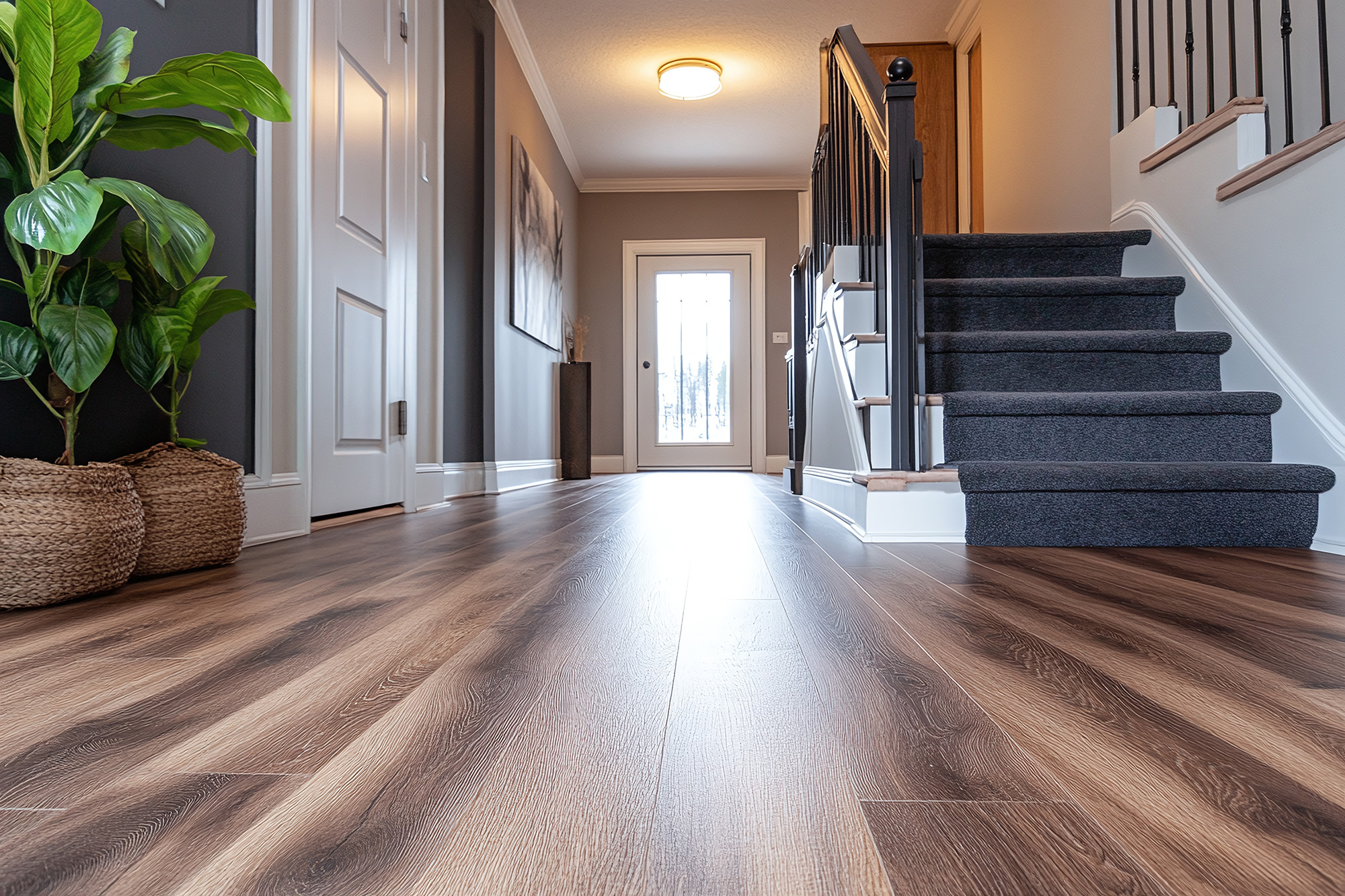
A stair carpet is only as safe as its installation, and stairs are the least forgiving place in the house to cut corners. Carpet earns its safety on steps two ways: the surface gives your foot grip that a hard tread doesn't, and the padding softens the landing in a fall, which matters most for the very young and the older adults the injury data flags as most at risk. That risk is not only the frail elderly, either, since the same study found the youngest seniors, those 65 to 74, accounted for 46.9 percent of the upper-extremity fractures. Active people fall too. To deliver that safely, the carpet has to be stretched tight and fastened down hard so it can never shift or ripple underfoot, and the cushion under it has to be the firm, thin kind. The Carpet and Rug Institute is specific here: for stairs and heavy-traffic areas it calls for a thinner, firmer cushion, no more than 7/16 inch thick and at least 1/4 inch, at 6 pounds per cubic foot, and a firmer 8-pound pad no thicker than 3/8 inch under low-profile berber. A thick, soft bedroom pad on a stair is a hazard, because it lets the carpet flex and the foot roll. This is exactly the judgment a professional install brings, and it's why we don't recommend a staircase as a first do-it-yourself carpet job.
Carpet spec cheat sheet for stairs and high-traffic areas
| Spec | What to look for | Why it matters on stairs |
|---|---|---|
| Fiber | Nylon or quality triexta | Springs back in the walk path instead of matting |
| Twist | Tight, well-defined tufts | Yarn stays bundled instead of fraying at the tips |
| Density | Backing barely visible when bent | Resists crushing better than a high face weight alone |
| Pile | Textured cut pile; loop if no pets | Hides seams and wear over each stair nose |
| Cushion | Firm and thin: 1/4 to 7/16 inch, 6 lb | Keeps the carpet from flexing and the foot from rolling |
| Install | Power-stretched and fastened | Never shifts or ripples underfoot |
Which carpet for which room?
Spend on durability where the house works hardest and save where it doesn't. Stairs, entry halls, and the main family room are the places to put a dense, tightly twisted nylon or triexta in a textured cut pile, because that's where matting shows up first and where a worn track is most obvious. A finished basement or a hallway with no pets can take a level-loop or berber for a clean, hard-wearing look. Bedrooms and formal sitting rooms, which see gentle traffic, are where a softer polyester plush makes sense and where you can prioritize feel over toughness. Carpet tile is worth a look for a basement, a playroom, or a home office, since a single stained or damaged tile lifts out and swaps in without redoing the floor. You can browse the full range in our carpet selection and the modular options in carpet tile.
Common questions about carpet for stairs and high-traffic areas
What is the best carpet fiber for stairs?
Nylon is the best carpet fiber for stairs because it's the most resilient, springing back after each footstep instead of matting down in the walk path. A quality triexta is a close second, with good durability and built-in stain resistance. Whichever you choose, a tight twist and a dense pile matter as much as the fiber name.
Is berber carpet good for stairs?
Berber can work on stairs and wears very well, but it comes with two cautions. Its loops can snag and run if a pet claws them, and its low, dense profile can look strained where it bends over each stair nose. If you have pets or a steep staircase, a textured cut pile is usually the safer choice; without pets, a quality berber is a durable option.
What carpet is best for high traffic with pets?
For high traffic with pets, a dense, tightly twisted cut pile in nylon or triexta is the best all-around choice, since cut pile can't be snagged into runs the way a loop can, and both fibers resist crushing. Triexta and some nylons add built-in stain resistance, which helps with accidents. Avoid loop styles in a pet home, and skip soft, low-density plushes that mat quickly.
Do stairs need special carpet padding?
Stairs need a firm, thin cushion rather than the plush pad used in bedrooms. The Carpet and Rug Institute recommends no more than 7/16 inch thick at 6 pounds density for high-traffic areas, and a thick, soft pad on a stair is unsafe because it lets the carpet flex and the foot roll. The pad also has to be fastened so nothing shifts on the step.
How long does carpet on stairs last?
A well-chosen, well-installed stair carpet commonly lasts many years, while a poorly chosen one can look worn in just a few. The difference is almost entirely the specs and the install: a dense, high-twist nylon or triexta, power-stretched over a firm pad, outlasts a soft, loosely tufted carpet on a cheap pad by a wide margin in the same spot.
Get the right carpet on your stairs
The safest, longest-lasting stair carpet is a dense, tightly twisted, resilient fiber installed tight over a firm pad, and picking it is easier with the samples in front of you. If you're carpeting stairs or a high-traffic room in the Lincoln area, request a free consultation and we'll measure the steps, show you the fibers and pile types side by side, and install it the way a staircase needs to keep it safe.