In the 2025 Houzz Kitchen Trends Study, the annual survey Houzz runs of thousands of homeowners actually renovating their kitchens, Shaker doors led at 61 percent of new and upgraded cabinets, flat-panel took 22 percent, and raised-panel came in at 12 percent. That single set of numbers answers the question most people are really asking when they compare the two styles. Raised-panel is no longer the default, and flat-fronted doors have taken over the modern kitchen. But the share of the market a door wins is a poor way to choose your own, because the flat-panel and raised-panel decision is mostly about how the door is built, how it cleans up, and whether you plan to paint it or stain it.
Both styles are good doors. Either one, made by a quality shop, will outlast the trend that made you pick it, so you're really choosing for how you live with it. What follows is the honest comparison: what actually separates a flat-panel door from a raised-panel one, whether raised-panel really is dated, which is easier to keep clean, and how the choice changes once you decide between paint and stain in a Lincoln kitchen that swings from bone-dry winters to humid summers.
What is the actual difference between a flat-panel and a raised-panel door?
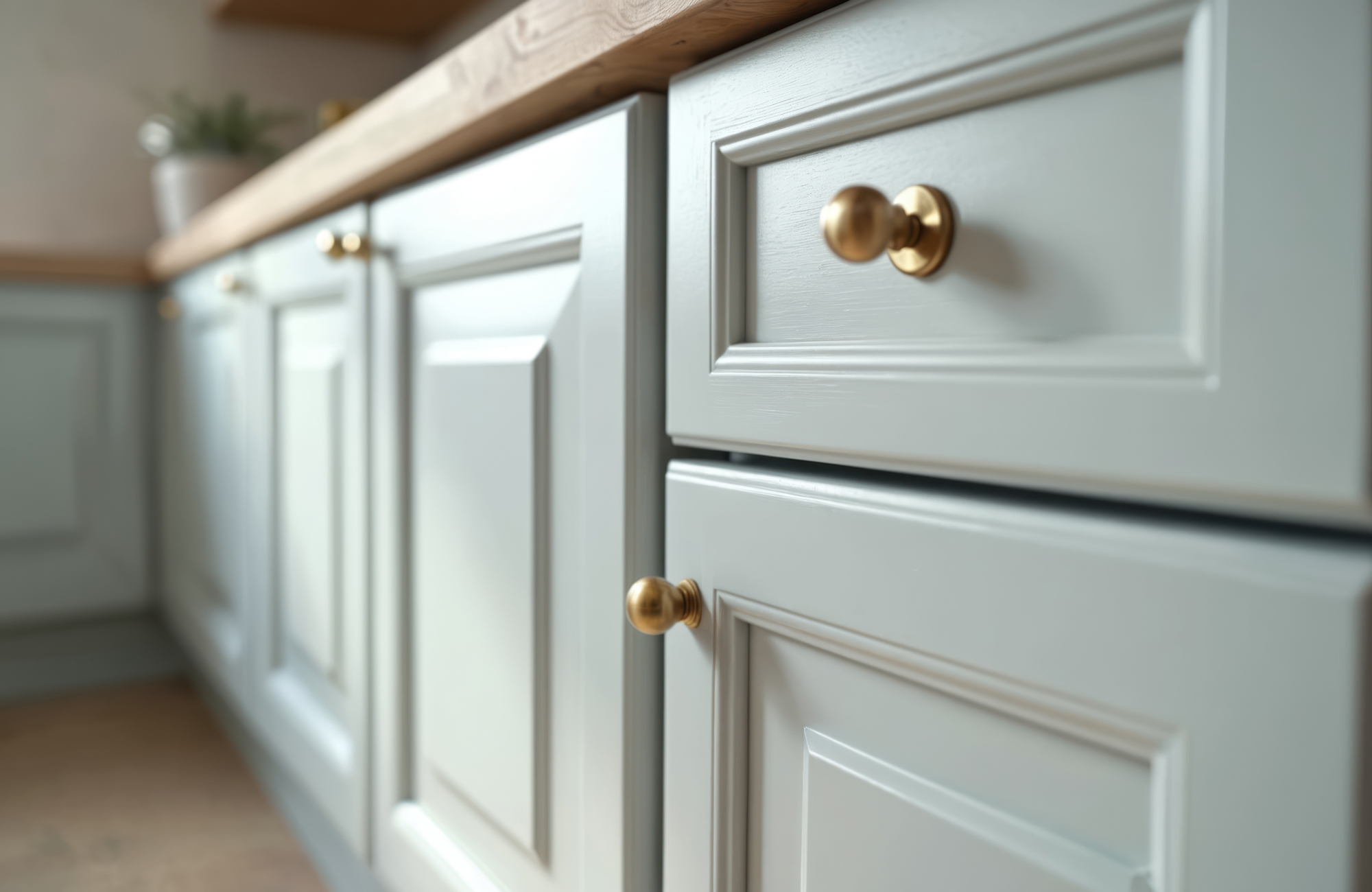
The difference is the center panel: a flat-panel door has a flat center that sits recessed inside the frame, while a raised-panel door has a thicker center that is profiled and stands proud, with a contoured edge stepping up toward the middle. Most cabinet doors are built the same way underneath, as a five-piece door: two vertical stiles and two horizontal rails make a frame, and a fifth piece, the center panel, drops into a groove in that frame. What the shop does with that fifth piece is the whole conversation.
Shaker doors are the version most people picture when they hear flat-panel. A Shaker door is a five-piece door with a plain square-edged frame and a flat recessed panel, and its clean right angles are why it reads as simple and current. A slab door goes further still and drops the frame entirely: it's a single flat front with no panel at all, the look behind the handleless, flat-fronted kitchens you'll see in design magazines. A raised-panel door keeps the same frame but swaps in that sculpted center, which is what gives a traditional kitchen its depth and shadow lines.
Are raised-panel cabinets dated or out of style?
Raised-panel cabinets are a minority of what people install today, but calling them dated misses what is actually happening. The Houzz study puts raised-panel at 12 percent of recent installs against 61 percent for Shaker, and the momentum runs the same direction: the NKBA and KBIS 2026 Kitchen Trends Report, published by the National Kitchen and Bath Association, the trade group whose members design and build most of the country's kitchens, found that 69 percent of design professionals expect the flat, slab door to keep gaining ground over the next three years. Glass-front doors, for reference, sit at just 3 percent. The market has clearly moved toward flat and simple.
A raised-panel door is not a mistake, though. Style follows the house. A raised-panel door belongs in a traditional or transitional home, a Craftsman, a colonial, or any kitchen where the trim, the doors, and the moldings already carry that kind of detail, and dropping flat slab doors into those rooms can look as out of place as the reverse. What reads as dated is almost never the raised panel itself. It's a heavy oak raised-panel door in a golden, orange-toned stain from a couple of decades back, and the same door profile in a soft painted white or a current stain looks nothing like it. If resale is on your mind, the safe money is on Shaker, which sits comfortably in almost any house and has held the top spot for years. If you love the look of a traditional kitchen and plan to stay in it, a raised-panel door is a fine choice that will still look intentional long after the trend charts move again.
Which door style is easier to keep clean?
Flat-panel and Shaker doors are easier to keep clean than raised-panel doors, and the reason is geometry. A raised-panel door has profiled grooves and a stepped center, and in a kitchen those recesses collect cooking grease, dust, and the fine film that settles near a stove. You end up working a cloth into the contours to get them clean. A Shaker door has one shallow square reveal where the panel meets the frame, and a slab door has nothing at all, so a wipe down the face does the job. If the cook in your house fries often or the kitchen sees heavy daily use, that difference shows up every week.
The finish matters as much as the shape, and a quality door is built to take the abuse. Cabinets that carry the ANSI/KCMA A161.1 seal have been through a battery of tests run by the Kitchen Cabinet Manufacturers Association, the industry body that sets the performance and construction standards American cabinet makers build to. In the finish portion, a door is held in a hotbox at 120 degrees Fahrenheit and 70 percent humidity for a full day, cycled back down toward minus 5, then left under spills of vinegar, citrus juice, coffee, ketchup, olive oil, and 100-proof alcohol to prove the coating doesn't cloud, lift, or stain. A door that earns the seal has already survived worse than your Tuesday dinner, whether the panel is flat or raised. What wears a finish down isn't the occasional splash. It's abrasive pads and harsh cleaners, and that holds true whichever profile you choose.
Painted or stained: how the door style changes the finish decision
Whether you paint or stain your cabinets steers the door decision more than most homeowners expect, and it comes down to what the center panel is made of. Painted doors are usually built with a center panel of medium-density fiberboard, an engineered wood panel with no grain and no seasonal movement to speak of. That stability is exactly what a painted finish wants, because paint bridges the joints of a door and any movement in the wood underneath can crack the paint line where the panel meets the frame. A flat or Shaker painted door, with its simple recessed panel, gives paint the least complicated surface to sit on and the fewest edges to crack.
Stain is the other way around. Stain wants real wood grain to show, so stained doors are typically solid wood throughout, raised panel included, and the grain running through a sculpted raised center is part of what makes a traditional stained kitchen look rich. The trade-off is movement. Solid wood swells in a humid Nebraska summer and shrinks through a long heating season with the furnace running, and a raised panel is designed to float in its frame so it can move without splitting. That's normal, though it can reveal a thin unstained line at the panel edge in the dry months. Keeping indoor humidity from crashing in winter, a job a simple humidifier handles, keeps that movement gentle whichever door you choose.
Cost and durability: what really separates the two
A raised-panel door usually costs a little more than a flat-panel or Shaker door of the same material, because the sculpted center takes more machining and more wood. Slab doors can run in either direction depending on the surface, since a plain slab is simple to make but a painted or high-gloss slab has to be flawless across the whole face, with nowhere for a blemish to hide. Across all of them, the bigger money question is the box behind the door and the material of the door itself, which is where a quote really moves. We walk through what drives those numbers in our guide to what actually drives a cabinet quote.
Durability tracks construction and finish far more than it tracks the panel shape. A well-built flat-panel door and a well-built raised-panel door should both last decades, which is the point of a standard like A161.1: it puts a door through 25,000 open-and-close cycles and loads a wall cabinet to 600 pounds before the cabinet earns its seal, regardless of the style on the front. The same standard loads every shelf and cabinet bottom to 15 pounds per square foot and holds it there for seven days, and pulls on the base cabinet joints with 250 pounds, so the box under your counter is proven well beyond what a stack of dishes will ever ask of it. The failure points to ask about are the joints, the hinges, and the finish. The panel shape barely comes into it.
Flat-panel vs. raised-panel cabinets side by side
| What matters | Flat-panel / Shaker | Raised-panel |
|---|---|---|
| Look | Clean, simple, contemporary or transitional | Detailed, traditional, more shadow and depth |
| Current demand | Shaker 61%, flat-panel 22% of recent installs | 12% of recent installs |
| Cleaning | Wipes clean; one shallow reveal or none | Grooves and contours collect grease and dust |
| Best finish | Paint, on a stable MDF center panel | Stain, on solid-wood grain |
| Typical cost | Lower for a standard Shaker; slab varies | Usually a step up for the machining |
| Fits | Modern, farmhouse, transitional homes | Traditional, Craftsman, colonial homes |
Which door style fits your kitchen?
Match the door to the house you actually have, then to how you cook. A newer build or an open-plan remodel usually looks best with Shaker or slab doors, which keep the sightlines quiet and let a bold countertop or backsplash carry the room. An older Lincoln home with detailed trim, a formal dining room, and existing traditional woodwork tends to look most settled with a raised-panel or a transitional door that echoes what is already there. If several cooks share the kitchen and it works hard every day, the easy-clean face of a flat or Shaker door earns its keep. Seeing the profiles in person settles it faster than any photo, and our showroom has the styles side by side so you can run a hand over a raised panel and a Shaker before you commit. There is more on the range in our overview of cabinet door styles, and on lines and construction in our cabinet information.
Common questions about flat-panel and raised-panel cabinets
What are raised-panel cabinets?
Raised-panel cabinets have a door whose center panel is thicker and sculpted so it stands up above the recess, with a contoured edge that steps toward the middle. That profile is what gives a traditional kitchen its shadow lines and depth. The rest of the door is the same five-piece frame used on most cabinet doors.
Are raised-panel cabinets out of style?
Raised-panel cabinets are a smaller share of new kitchens than they used to be, at about 12 percent of recent installs against 61 percent for Shaker, but they are not out of style in a traditional home. What tends to look dated is a heavy orange-toned oak raised panel from decades ago, and the same profile in a fresh paint or a current stain reads as classic rather than old.
Do flat-panel and slab cabinets show fingerprints?
A flat or slab door can show fingerprints and smudges more than a busy raised panel, especially in a dark color or a high-gloss finish, because there is nothing on the face to break up the reflection. A matte or satin finish hides prints far better than gloss, and it is the easier choice to live with in a working kitchen.
Can you paint raised-panel cabinets?
You can paint raised-panel cabinets, and a painted raised panel is a common way to keep the traditional shape while updating the color. The one thing to watch is that solid-wood raised panels move a little with the seasons, so a hairline can appear at the panel edge in dry months. A painter who preps and finishes for that, or a factory-painted door built with a stable center panel, keeps it clean.
Which cabinet door style is best for resale?
Shaker is the safest door style for resale because it suits almost any house and has stayed the most popular choice for years, so it appeals to the widest set of buyers. In a genuinely traditional home, a well-finished raised-panel door can be the stronger fit, since buyers expect the kitchen to match the rest of the house.
See the styles for your kitchen
Flat-panel and raised-panel doors are both good choices, and the right one comes down to your house, your finish, and how hard your kitchen works. If you want to see them together and talk through paint versus stain for a Lincoln kitchen, request a free consultation and we will bring the door samples, measure your space, and help you land on a style you will still like in ten years.